White-label web development means another team designs and builds websites, Shopify stores or WordPress sites for your clients, and your agency delivers the work under its own brand. Your client sees your name, your process and your account manager. The partner works behind the scenes, follows your standards and hands everything back to you.
For marketing, design and digital agencies, it is a way to take on more projects, or projects that need skills you do not have in-house, without hiring and training new staff. This guide explains how white-label development works step by step, what agencies usually outsource, the real benefits and risks (and how to reduce each one), how to choose a partner and how pricing is usually structured.
What is white-label web development?
In a white-label arrangement, the partner is invisible to your client. You sell the website, agree the price and own the relationship. The partner does some or all of the design, development and testing, and you present the finished work as your agency's own.
It is different from simply referring a client elsewhere. With a referral, the client leaves your hands. With white-label work, you stay the client's point of contact, you control quality and sign-off, and you keep the margin between what you charge the client and what the partner charges you.
Agencies use it in three common ways:
- Overflow: your team is full, and a new project arrives that you do not want to turn down.
- Specialist work: a client asks for something outside your team's skills, such as a custom Shopify theme, a WooCommerce store or a React web app.
- A standing delivery team: you sell the strategy and design, and a partner handles most of the build, project after project.
How white-label development works, step by step
Every partner has its own process, but a well-run white-label project usually follows these six steps.
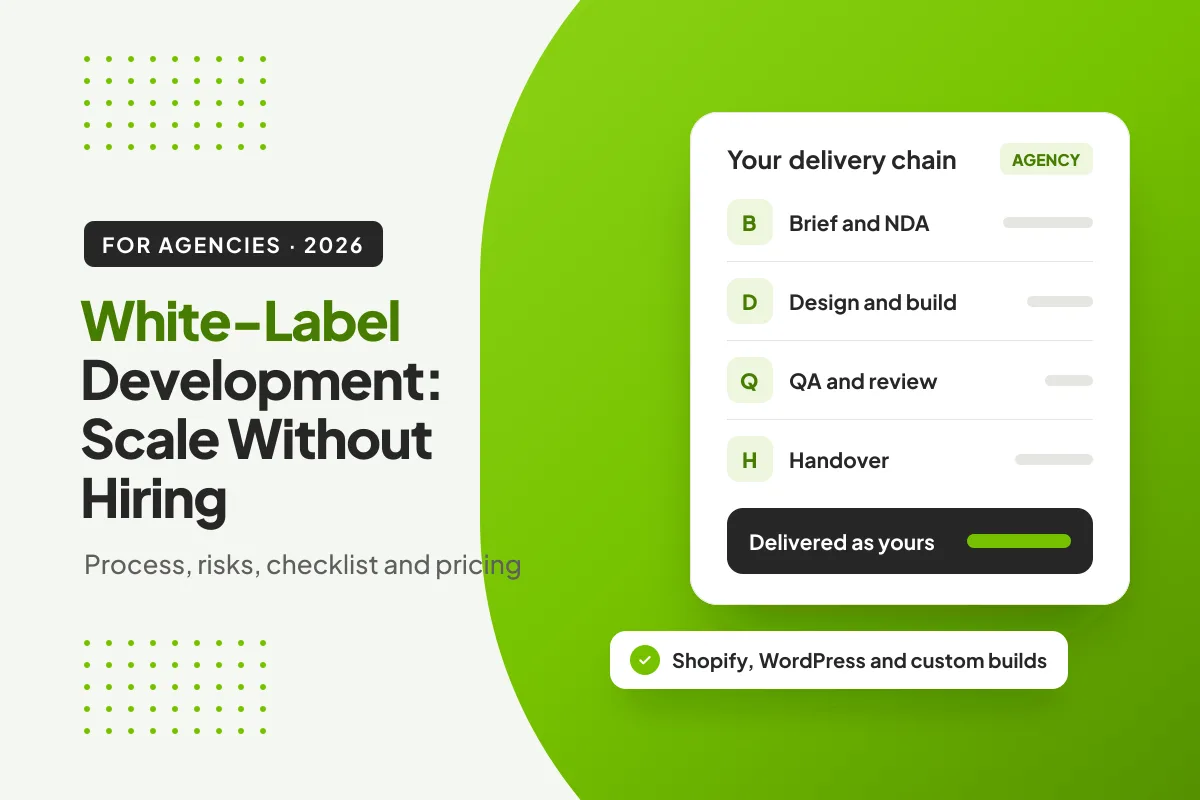
- Brief. You share the client's goals, the scope, designs or wireframes if you have them, brand guidelines, deadlines and your own quality standards. The more context the partner gets, the fewer questions reach your client later.
- NDA and scope. The partner signs a non-disclosure agreement before seeing client details. You then agree deliverables, timeline, price and payment milestones in writing, along with who owns the finished code and files.
- Your brand and your rules. Agree how the work is presented: whose name appears on staging links, documents and handover notes, whether the partner ever joins client calls, and how they would be introduced if they do.
- Communication. Decide on one channel and one point of contact on each side. Many agencies give the partner access to their project management tool, repository and chat, so the work sits inside the agency's normal workflow, with regular check-ins planned around both teams' working hours.
- QA and review. The partner tests the work before you see it. You then review each stage against your own quality bar before anything reaches the client.
- Handover and launch. The partner launches the site or hands over the complete code, files and access, so your agency can support the client after launch or bring the partner back for the next change.
Platform access without sharing passwords
Both major platforms let you give a partner access without handing over the client's own login. On Shopify, Partners can request collaborator access to a store; the store owner approves the request and chooses which permissions to give, and Shopify says collaborator accounts do not count toward a store's staff limit. On WordPress, you can create a separate user account for the partner with a suitable user role. An Administrator has access to all administration features of a single site, so give that role only when the work needs it, and remove access when the project ends.
What agencies typically outsource
Most agencies keep strategy, account management and often brand and creative direction in-house, and outsource the parts that need specialist development time:
- Shopify development: theme builds and customization, custom sections, app setup and integrations, and store migrations. See Shopify development.
- WordPress development: custom themes, Elementor or block-editor builds, plugin customization, speed work and ongoing care. See WordPress development.
- WooCommerce stores: product setup, payments, shipping and migrations.
- Design-to-code: turning your designers' Figma files into a working, responsive site.
- Custom web apps: React, Next.js and Node.js builds, dashboards and API integrations. See web development.
- Maintenance and updates: the steady flow of small changes that eats into your senior team's time.
- Technical SEO and automation: on-page and technical SEO for the sites you deliver, or AI and CRM automation for clients who ask for it.
Benefits and risks, and how to reduce each
White-label development solves real capacity problems, but it also adds a link to your delivery chain. Here is an honest view of both sides.
The benefits
- Say yes to more work. You can accept projects your current team could not deliver on time.
- No hiring delay. Recruiting a developer takes time and adds a fixed salary. A partner can start once the scope is agreed.
- Capacity that follows your pipeline. Use one developer in a quiet month and a small team in a busy one.
- Wider service list. Offer Shopify, WooCommerce or custom development without building those skills from scratch.
- Your team stays focused. Your people spend more time on strategy, creative work and clients, and less on production.
The risks and how to manage them
| Risk | What it looks like | How to reduce it |
|---|---|---|
| Quality gaps | Work that does not match your standards or your other projects | Share a written quality checklist, start with a small paid project and review every stage before the client sees it |
| Missed deadlines | Delivery slips and you find out late | Break the work into stages with dates, ask for regular progress updates and keep a buffer before the client deadline |
| Communication gaps | Questions sit unanswered across time zones | Agree one channel, named contacts, response expectations and a fixed overlap time for calls |
| Confidentiality | Client details or the partnership itself are exposed | Sign an NDA before sharing anything and agree how the partner is presented, if at all |
| Ownership disputes | Unclear who owns the code, designs and accounts | Put ownership in the contract: code and files go to your agency or your client on payment |
| Access and security | Shared passwords and old accounts left open | Use collaborator or separate user accounts, give only the permissions needed and remove access at handover |
| Dependence on one partner | Only the partner understands how the site was built | Ask for clean, documented code in your repository, so any developer can pick it up |
How to choose a white-label partner: a checklist
Before you put a partner in front of your clients, even invisibly, check these points:
- Relevant work. Have they built sites or stores like the ones you sell? Ask to see live examples on your main platforms.
- In-house team or subcontractors. Ask who will actually do the work and whether it stays within their own team.
- Platform depth. For Shopify and WordPress work, ask how they handle themes, custom functionality, performance and updates.
- Process. How do they plan, test, review and launch? Do they test before handing work to you?
- Communication. Will they work in your tools? Who is your contact, and when are they available relative to your working hours?
- Confidentiality. Will they sign an NDA before seeing client details, and stay out of sight of your clients if you prefer?
- Ownership. Does the contract give your agency or your client full ownership of the code and files?
- Flexible models. Can they take fixed-scope projects as well as provide a dedicated developer for ongoing work?
- Reviews and track record. How long have they been in business, and what do past clients say?
- A trial project. Are they willing to start with a small, well-defined job so you can judge the fit?
If you are still weighing up whether to use a freelancer or an agency for this kind of work, our guide on how to hire a freelancer or agency compares the two in more detail.
White-label pricing models
White-label partners usually charge in one of three ways. The right one depends on how predictable your pipeline is.
| Model | How it works | Best for | Watch out for |
|---|---|---|---|
| Project-based | A fixed price for a defined scope, often paid in milestones as stages are approved | One-off sites and stores with a clear brief | Scope changes need a change request and a revised quote |
| Dedicated developer or team | A set number of hours each month from developers who work only on your agency's projects | Agencies with a steady flow of client work | You pay for the hours whether or not the pipeline fills them |
| Hourly | You pay for the hours used, with time logs | Small tasks, fixes and maintenance | Totals are harder to predict on larger jobs |
When you price white-label work to your client, remember to include your own time: briefing, project management, reviews and client communication. That time is real even when the build itself is outsourced. If you sell WordPress sites, our guide to what a WordPress website costs breaks down the running costs, such as hosting, themes and plugins, that sit alongside the build.
At Shreeji Software, dedicated developers are available on three plans: Full-time (160 hours a month), Part-time (80 hours a month) and Hourly (billed on hours used). You can interview developers before they start. See hire a dedicated developer, or build a dedicated team if you need designers and developers together.
Common mistakes to avoid
- Starting with your biggest client. Test a new partner on a smaller project first.
- A thin brief. Missing details turn into assumptions, and assumptions turn into rework.
- No review step. Never pass a partner's work straight to a client without checking it yourself.
- Unclear ownership. Agree in writing who owns the code, designs and accounts before work starts.
- Forgetting post-launch support. Decide who handles fixes and updates after launch, and how they are charged.
White-label development with Shreeji Software
Shreeji Software is an in-house design and development team with 15+ years in business and 1800+ client reviews on Freelancer. We work as a remote partner from Ahmedabad, India, for agencies that sell Shopify, WordPress, WooCommerce, UI/UX, React and AI automation projects to their clients. Your agency keeps the client relationship and the brand; we sign an NDA before work begins, and the finished code and files belong to your agency or your client, as you agree. We can take whole projects, individual tasks or provide dedicated developers. Learn more about our white-label development for agencies.